How We Use AI at Wheelworks (And Most Importantly: Where We Never Will)
Let's start with what we don't use AI for. When you email us, a person reads it and a person writes the reply. There's no chatbot on our website, and when you call, you're talking to someone who builds wheels. That isn't changing.
We're never using it to shortcut a process, cut corners, or generate slop.
So where does AI fit? It does the repetitive, boring work that used to eat our week, so we have more time for the part of the job that matters most: building great wheels, and looking after you.
Just as importantly, AI tools are making us enjoy our jobs more.
Why we use it
AI is giving us more time, and it's taking non-core cognitive load away from us.
Wheelworks is a small team. Every hour spent sorting email, chasing paperwork or keeping systems running is an hour not spent talking you through a build, or answering a technical question.
It also makes our jobs more enjoyable. Removing the boring and frustrating bits of the job and freeing up mental energy means we're happier and we can better focus on building exceptional wheels.
AI has been the biggest change to how we run the business in years, and that time is going straight back into the virtuous loop of building more of the tools that free up even more of it.
Tools in days, not months
I studied Computer Science over 25 years ago and I've always written software for Wheelworks. The difference with AI helping to write, test, and deploy the code is the speed of development — tools that would have taken me months to create now take days.

The dark days of writing code are over
The Wheelworks Mail Classifier
If you've been into our shop you've probably noticed how tidy and organised our workspace is, and we also put the same effort into the digital equivalent.
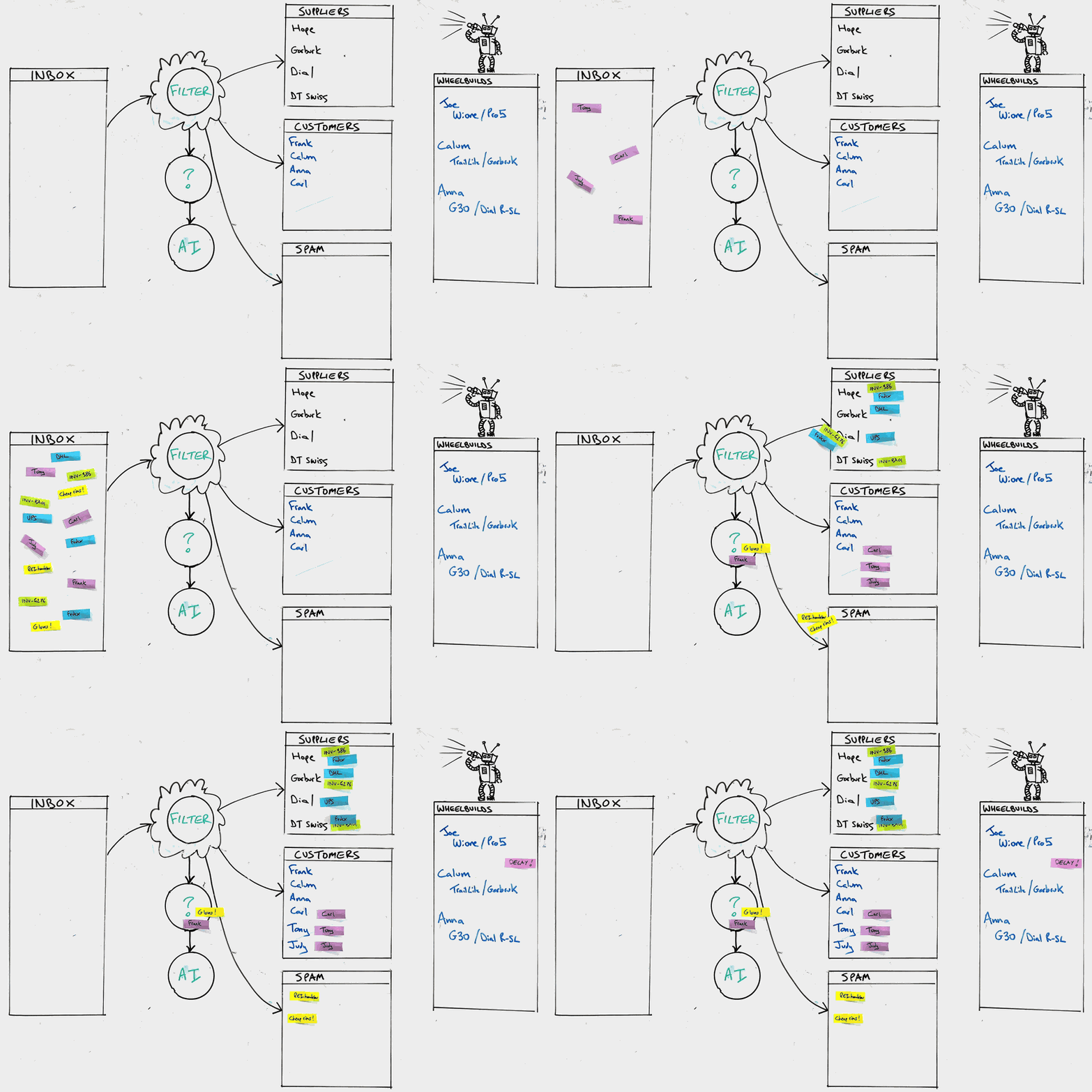
Our inbox is a good example. Customer questions arrive in the same place as supplier invoices, courier tracking updates, order confirmations, supplier newsletters and a steady stream of spam. Until recently, a person had to sort through all of it before getting to the emails that actually needed an answer.
So we built a Mail Classifier, with AI helping us write it. Now every new email is sorted the moment it arrives. A set of plain, predictable rules does the bulk of the work: the courier's tracking updates go here, a supplier's invoices go there, the same way every time.
The few emails the rules can't clearly place get passed to an AI model, and it makes one decision: does someone here owe this person a reply? If yes, it goes straight to customer support. If not, it's filed with the accounts and admin work. If it isn't sure, it leaves the email where it is for a person to look at.
Tracking emails are then matched against purchase orders, and their receipt date is kept updated multiple times per day. We can then clearly see if a custom pair of hubs has been delayed in shipping, and we can easily re-schedule the wheelbuild and keep our customer in the loop.
The tool filters information and keeps things organised. It doesn't reply, and it doesn't decide what we say. It just makes sure your email question reaches either myself or Andrew faster, and it magically files the rest of the important info so we can act on it when needed.
Catching mistakes before a wheel is built
Every Wheelworks wheel is built to your spec, and a custom spec has a lot of details to get right: rim, hubs, spokes, spoke lengths, lacing, valve, tape. We now run 30-something pre-build checks in our order system that look over every order before it reaches the build queue, catching a mismatched part, a forgotten component, or a missing shipping address while it's still a quick fix.
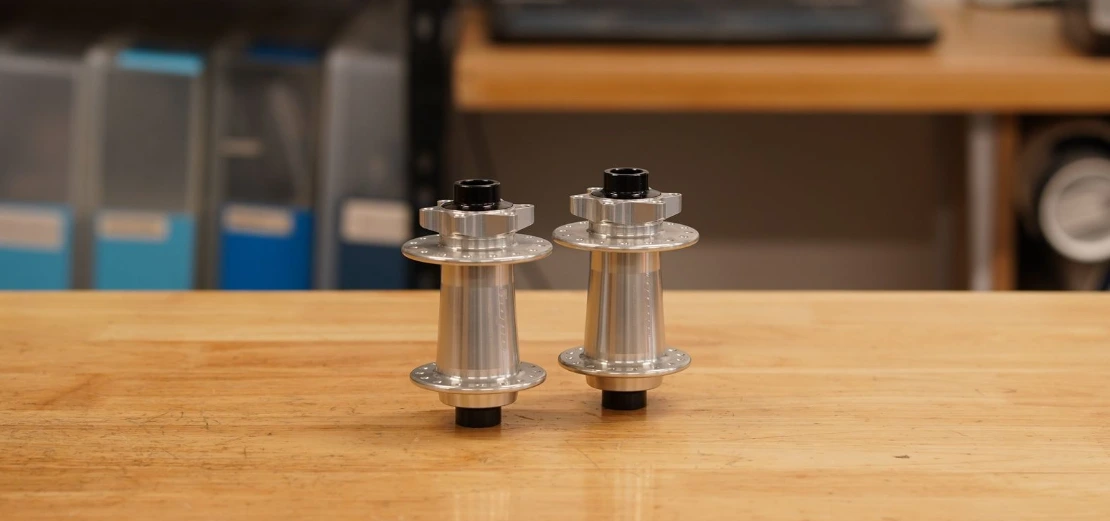
These two hubs are slightly different. There are another 488 variants of this hub which also look pretty similar, and automation helps us not pick the wrong one.
For example there are 490 variants of the Hope Pro5 front hub, and 1176 variants of the rear hub. As a human it's error-prone to choose which SKUs are needed from a long list, so these pre-build checks ensure the front hub and rear hub are the same colour and have the same brake mount type, and ensure that the front rim and the front hub have the same spoke count. We would pick up an error such as mis-matched brake rotor mount while building, but these automated checks solve the problem as far upstream as possible, reducing time, reducing mis-purchased inventory, and removing frustration from our days.
AI helped us write those checks. What it checks for came from us, from years of building wheels and knowing exactly what goes wrong when.
We're not asking AI how to build a wheel
There's a lot of AI slop out there, and the bike industry has had its share. Earlier this year REI (a massive US sport retailer with nearly 200 stores) ran an Instagram ad showing a bike with two sets of handlebars, a missing crank arm and the disc brake on the wrong side.[1] The image had been altered by an AI tool, and it ran for around a week before being pulled.[2] Clearly nobody who knew bikes looked at it before it went out.

REI's Instagram ad as it ran. Two sets of handlebars, a missing crank arm, and both rim-brakes and disc brakes.
That's the hard line for us. AI is a tool in the hands of people who already know the job. We don't type "how do I build a bike wheel" and do what it says. We decide what needs doing, AI helps us build it faster, and we check the result. Your wheels are built by people, with attention to detail, the same way they always have been.
Using AI responsibly
A few principles guide how we use it:
- A person stays responsible. Anything that reaches you, from an email to a finished wheel, has been made or checked by someone here.
- AI helps write the code, it doesn't trawl through your records. Our tools run inside our own systems.
- Rules first, AI only when needed. Wherever a plain rule can do the job, it does. AI only reads an email when the rules can't clearly decide.
- Narrow jobs only. When AI does touch an email, it has one specific task, like sorting it into the right pile or picking a shipping address out of a reply and adding it to your order. It isn't writing a reply.
Questions?
If you'd like to know more about how we work, get in touch. A person will reply.
Sources